Pipeline Management for Government Contracts: A Stage-by-Stage Guide
Master government contracting pipeline management with this stage-by-stage guide covering FAR thresholds, capture gates, IDIQ tracking, and weighted pWin models.
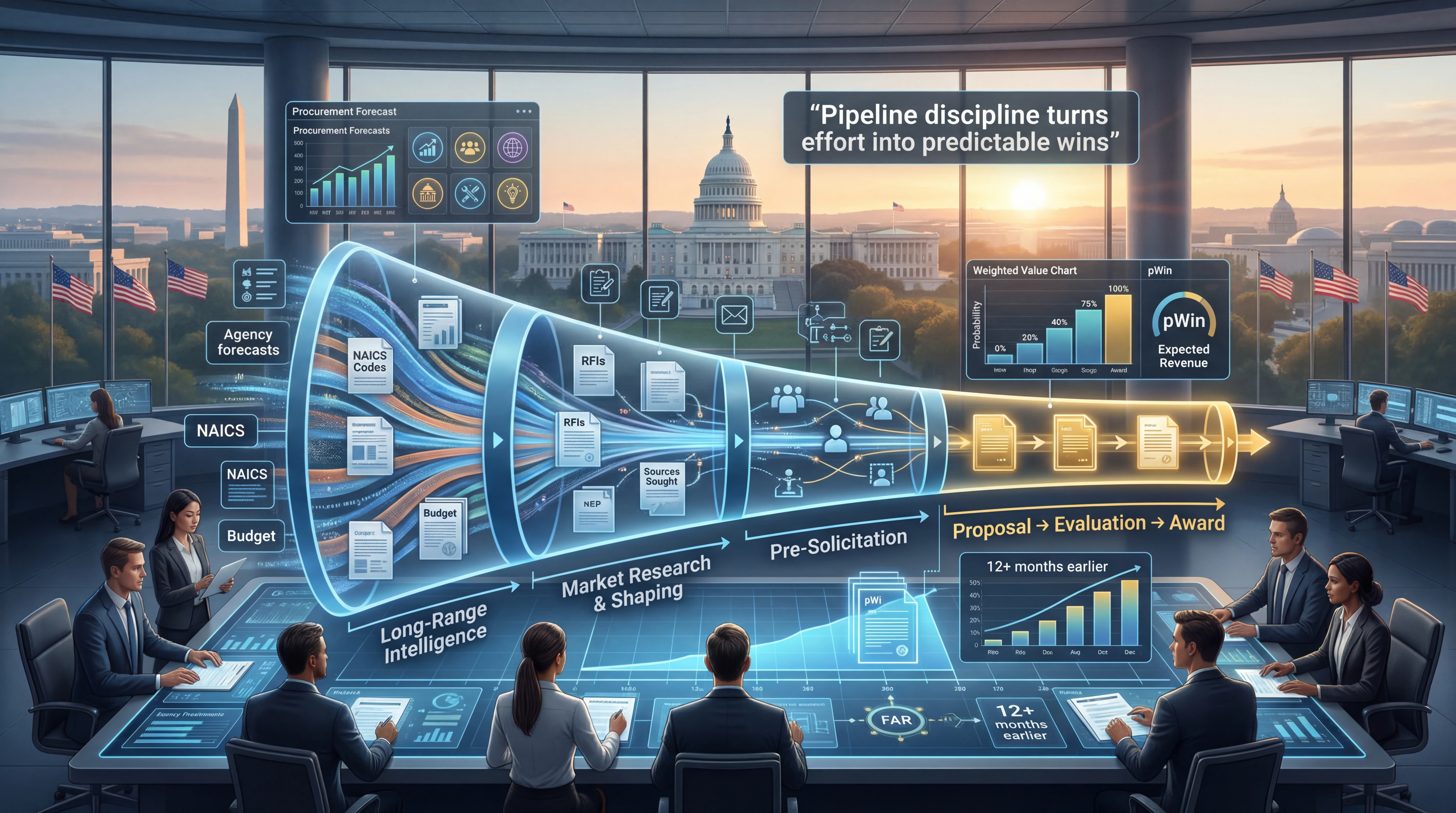
This article walks you through how to build and manage a pipeline for federal government contract opportunities — from the earliest whisper of agency need all the way through award, debrief, and lessons learned. By the end, you will understand the specific stages a pursuit moves through, the federal signals that mark each stage, the regulatory thresholds that should drive your prioritization decisions, and how to calculate a weighted pipeline value so you can allocate capture resources wisely. Whether you are figuring out how to win government contracts for the first time or refining a mature capture operation, this framework will give you a structured, repeatable system grounded in the Federal Acquisition Regulation (FAR) — the rulebook that governs most federal purchasing [1].
What This Article Covers — and Why It Matters
By the end of this guide, you will understand:
- The six pipeline stages a federal pursuit moves through and the public signals that mark each one
- The FAR thresholds that fundamentally change how agencies buy — and how to prioritize based on them
- How to manage a separate IDIQ and task-order pipeline under FAR 16.505 fair-opportunity rules
- How to calculate a weighted pipeline value using stage probabilities and pWin
- How set-aside strategy and teaming logic should shape your pipeline decisions
- How to use debriefs, protests, and public postings as pipeline governance tools
Why a Pipeline Beats a Scramble
Most companies that lose in government contracting do not lose at the proposal stage. They lose months earlier, when they either missed the opportunity entirely or discovered it too late to shape the outcome. A government contracting pipeline is simply an organized way to track every opportunity you are considering, pursuing, or waiting on — sorted by how far along it is and how likely you are to win it. Think of it like a funnel: many opportunities enter at the top; only the ones you can realistically win and profitably perform survive to the bottom.
The discipline comes from building stage gates — decision points where you ask hard questions before investing more time, money, or personnel. Without gates, teams chase everything, burn out their proposal staff, and submit mediocre bids. With gates, you concentrate firepower on pursuits where you have real advantages. That is the core of capture management under the FAR framework, and it is how experienced firms consistently learn how to win government contracts in competitive markets.
The Six Pipeline Stages, Mapped to Federal Signals
Federal procurements follow a surprisingly predictable sequence of public signals. Your pipeline stages should mirror them. Below is a practical mapping, along with the artifacts you should be collecting at each gate.
Stage 1: Long-Range Intelligence
Every federal agency publishes strategic plans, budget justifications, and — thanks to Small Business Administration (SBA) rules at 13 CFR 125.2(e) — procurement forecasts through its Office of Small and Disadvantaged Business Utilization (OSDBU) [10]. These forecasts tell you what an agency plans to buy in the coming fiscal year, often with estimated dollar ranges and North American Industry Classification System (NAICS) codes (the government’s way of categorizing what kind of work a contract involves). At this stage, you are scanning — not committing. Your artifact checklist should include the customer agency, the mission area, the likely funding line, and the NAICS code with its associated SBA size standard, which determines whether your company qualifies as “small” for that particular purchase [9]. GovBidLab’s free NAICS Code Lookup tool lets you validate the correct code and size standard early so you can segment pursuits by set-aside eligibility before you invest capture dollars.
Stage 2: Market Research and Shaping
The FAR explicitly encourages agencies to engage with industry before writing a solicitation. FAR 10.001–10.002 directs contracting officers to conduct market research, and FAR 15.201 permits “exchanges with industry before receipt of proposals” — including one-on-one meetings, industry days, and Requests for Information (RFIs) or sources-sought notices [3][4]. This is your shaping window. Responding to an RFI is not just a courtesy; it can influence whether the procurement is set aside for small businesses, what evaluation criteria appear in the final solicitation, and even the statement of work itself.
At this gate, your pipeline artifact should include a validated customer contact (do you have access to the program manager or end user?), a draft capability statement tailored to the requirement, and an initial teaming assessment — who fills your gaps? GovBidLab’s Capability Statement Generator can help you produce a polished, targeted document quickly for these early engagements. You should also verify your own registration and check competitors’ registrations using the UEI Lookup tool, since an expired or inaccurate SAM.gov profile can disqualify a bid before it is ever evaluated.
Stage 3: Pre-Solicitation and Draft RFP
Agencies sometimes release draft solicitations under FAR 5.205 (special notices) to gather industry feedback [2]. When a draft Request for Proposals (RFP) appears, treat it as a rehearsal. Build a compliance matrix — a spreadsheet that maps every requirement in the solicitation to your proposed response — and identify gaps. This is also the stage to firm up teaming arrangements, assess set-aside posture under FAR Part 19 (the small business section of the FAR) [5], and begin competitive intelligence in earnest: who is the incumbent, what does their Contractor Performance Assessment Reporting System (CPARS) profile look like, and is the government likely to use a Lowest Price Technically Acceptable (LPTA) evaluation (where the cheapest acceptable bid wins, per FAR 15.101-2) or a best-value tradeoff (where quality can outweigh price, per FAR 15.101-1) [4]? That distinction alone can determine whether you pursue or walk away.
Stage 4: Final Solicitation — Bid/No-Bid Decision
When the final RFP or Request for Quotations (RFQ) drops on SAM.gov [12], your gate decision is binary: bid or no-bid. This is where pipeline management earns its keep. If you have been tracking the opportunity since Stage 1, you arrive here with customer insight, a teaming strategy, competitive intelligence, and a near-complete compliance matrix. If you just found the opportunity today, you are already behind — and statistically, your probability of win (pWin) is low. Experienced capture teams set a hard rule: if we did not know about this opportunity before the RFP, we need an extraordinary reason to bid.
Stage 5: Evaluation and Award
After submission, the opportunity sits in evaluation. Your pipeline should reflect this as a distinct stage because you still have work to do: preparing for potential Evaluation Notices (ENs) or discussions if the contracting officer opens them, updating pricing assumptions, and — critically — keeping your proposed team committed. This stage can last weeks or months, especially for large Part 15 negotiated procurements.
Stage 6: Debrief and Lessons Learned
Win or lose, this stage closes the loop. If you lose, FAR 15.506(a)(1) gives you the right to request a debriefing within 3 calendar days of notification [4]. Debriefs are gold: they reveal how evaluators scored your proposal, where you fell short, and sometimes what the winner did better. They also affect your protest timeline — under Government Accountability Office (GAO) rules at 4 C.F.R. § 21.2, the protest clock can be tied to the debriefing date in certain “debriefing-required” procurements. Even if you win, document lessons learned and update your capture playbook.
Regulatory Thresholds That Drive Prioritization
Not every opportunity moves at the same speed or demands the same level of compliance rigor. The FAR defines several dollar thresholds that fundamentally change how the government buys — and therefore how you should manage your pipeline. The table below summarizes the most important ones.
| Threshold | Dollar Value | What It Means for Your Pipeline | Source |
|---|---|---|---|
| Micro-Purchase Threshold (MPT) | Generally $10,000 | Government can buy with a purchase card, minimal competition. Fast cycle; low capture investment needed. | FAR 2.101 [1] |
| Simplified Acquisition Threshold (SAT) | $250,000 | Purchases below this use streamlined procedures (FAR Part 13). Shorter timelines, fewer proposal sections, reduced protest risk. | FAR 2.101 [1] |
| Simplified Procedures for Commercial Items | Up to $7.5M ($15M for contingency/emergency) | Commercial items can use SAP-like streamlined buying up to these thresholds. Faster capture cycles for commercial sellers. | FAR 13.500 [6] |
| Subcontracting Plan Threshold | $750,000 ($1.5M for construction) | Large-business primes must submit small business subcontracting plans above this level — creating teaming demand for small firms. | FAR 19.702 [5] |
| J&A Posting Threshold | Above $25,000 | Justifications for sole-source or limited competition must be posted publicly — free competitive intelligence for your pipeline. | FAR 6.305 [7] |
| GAO Task-Order Protest Threshold (Civilian) | Above $10M | Below this, you generally cannot protest a task-order award to GAO. Affects risk calculus. | 41 U.S.C. § 4106(f) [11] |
| GAO Task-Order Protest Threshold (DoD/NASA/USCG) | Above $25M | Same concept, higher bar for Department of Defense, NASA, and Coast Guard. | 10 U.S.C. § 3406 [11] |
Understanding simplified acquisition threshold strategies is especially important for small businesses. Opportunities below the SAT tend to be set aside for small firms more frequently, move faster, and require less elaborate proposals — making them ideal for companies still building past performance. Above the SAT, you enter the more formal world of FAR Part 15 negotiated procurements, where evaluation criteria, past performance ratings in CPARS [13], and price-realism analyses demand significantly more capture investment.
IDIQ and Task-Order Pipelines: A Separate Track
If you hold a seat on an Indefinite-Delivery/Indefinite-Quantity (IDIQ) contract or a Governmentwide Acquisition Contract (GWAC), your pipeline needs a dedicated track for task and delivery orders. These orders are governed by FAR 16.505, not FAR Part 15, and follow fair-opportunity rules — meaning the government must generally give all contract holders a chance to compete for each order [8]. However, exceptions exist under FAR 16.505(b)(2), and when the government invokes one for orders above $25,000, it must post a justification publicly, much like a Justification and Approval (J&A) under FAR 6.305 [7][8]. Monitoring those postings is free intelligence.
For practitioners managing an IDIQ task order pipeline, a key nuance: the GAO protest thresholds noted above mean that below $10 million (civilian) or $25 million (DoD), your recourse if you lose a task order is limited primarily to the agency-level protest or the ordering contracting officer’s own review process. That should factor into your gate decisions — if a task order is below the protest threshold and you have a low pWin, the cost-benefit of a full capture effort shifts.
Also track on-ramp windows separately. Many IDIQ vehicles periodically re-open to add new holders. If you are not yet on a vehicle, those on-ramp deadlines belong in your open-market pipeline with their own pursuit timeline. For companies considering whether to pursue a GSA Schedule as a vehicle strategy, GovBidLab’s GSA Eligibility Calculator can help you assess whether building your own Schedule pipeline makes sense or whether partnering with a Schedule holder is the smarter path.
Calculating Weighted Pipeline Value
A pipeline full of opportunities is meaningless if you cannot prioritize. The standard approach is a weighted pipeline model: for each opportunity, multiply the estimated contract value by a stage probability (how likely any opportunity at that stage is to result in an award) and then by your pWin (your specific probability of winning). The result is a risk-adjusted revenue forecast that tells you where to allocate people and dollars.
Stage probabilities are rough benchmarks — for example, an opportunity at the RFI stage might carry a 10% stage probability because many RFIs never become solicitations, while one at the final-RFP stage might carry 70%. Your pWin is where the real analytical work happens. Tune it using concrete artifacts, not gut feelings: Do you have direct customer access? Is your technical solution mature? Have you completed a price-to-win analysis? Is your compliance matrix fully mapped? Have you identified and validated your discriminators — the specific reasons the evaluator should choose you over the competition?
For Department of Defense (DoD) pursuits, factor in cybersecurity compliance early. The Cybersecurity Maturity Model Certification (CMMC) framework can disqualify you at the last moment if your assessment is not current. GovBidLab’s CMMC Calculator helps you assess where you stand against DoD cyber requirements so you can avoid late-stage surprises that kill an otherwise strong bid.
Small Business Set-Aside Strategy and Teaming Logic
Your pipeline should tag every opportunity with its set-aside posture — whether the government intends to restrict competition to small businesses generally, or to specific socioeconomic categories such as 8(a) (a program for socially and economically disadvantaged firms), HUBZone (businesses in Historically Underutilized Business Zones), Service-Disabled Veteran-Owned Small Business (SDVOSB), or Women-Owned Small Business (WOSB) under FAR Part 19 [5]. This posture directly affects your bid-or-team decision.
For large businesses, the subcontracting plan thresholds — $750,000 for most contracts and $1.5 million for construction, effective August 31, 2020 — create a structural incentive to team with small firms [5]. If you are a small business, this is leverage: large primes pursuing contracts above these thresholds must submit a subcontracting plan with meaningful small business participation goals. Position yourself as a teaming partner well before the RFP drops, ideally during Stage 2 when the prime is still assembling its team.
Understanding how to win government contracts as a small business often means mastering this teaming dynamic. Your pipeline should track not only opportunities you will prime but also those where you are a subcontractor — with separate pWin estimates reflecting the prime’s competitiveness, not just your own.
Pipeline Governance: Debriefs, Protests, and Intelligence
Good pipeline governance extends beyond award. Build debrief requests into your standard operating procedure: the 3-day window under FAR 15.506(a)(1) is tight, and missing it means losing your best source of evaluator feedback [4]. Track GAO protest timelines — generally 10 calendar days from when you knew or should have known the basis for protest (4 C.F.R. § 21.2) — so you can make informed decisions quickly rather than scrambling.
Also mine publicly posted Justifications and Approvals (J&As) under FAR 6.305 and fair-opportunity exception justifications under FAR 16.505(b)(2)(ii)(D) as competitive intelligence [7][8]. When the government posts a J&A for an action above $25,000, it typically stays visible for 14 days (30 days for unusual and compelling urgency). These postings reveal upcoming sole-source awards and can alert you to work you might challenge or position for on the recompete. Feed this intelligence back into Stage 1 of your pipeline to improve future forecasting. Spending data on USAspending.gov [14] complements this by showing you who won what, for how much, and under which NAICS codes — critical for understanding how to win government contracts in your specific market segment.
What to Do Next
Start by auditing your current pipeline against the six stages described here. If you do not have defined stages and gate criteria, create them this week — even a simple spreadsheet with columns for stage, estimated value, pWin, and weighted value will immediately sharpen your prioritization. Validate the NAICS codes and set-aside eligibility for every active pursuit using GovBidLab’s NAICS Code Lookup tool, and set a calendar reminder to check agency OSDBU forecasts and SAM.gov postings weekly. The companies that win consistently are not the ones with the best proposal writers — they are the ones who saw the opportunity first and prepared longest.
Glossary of Terms Used in This Article
8(a) — An SBA business development program for firms owned by socially and economically disadvantaged individuals. Contracts can be sole-sourced or set aside for 8(a) participants.
Capture Management — The structured process of pursuing a specific government contract opportunity from initial identification through proposal submission, with defined decision gates along the way.
Compliance Matrix — A spreadsheet or document that maps every solicitation requirement to the corresponding section of your proposal, ensuring nothing is missed.
CMMC — Cybersecurity Maturity Model Certification — a DoD framework requiring contractors to meet verified cybersecurity standards before handling controlled unclassified information.
CPARS — Contractor Performance Assessment Reporting System — the government’s database for recording evaluations of contractor performance on federal contracts.
DoD — Department of Defense — the federal department responsible for military and national security operations.
FAR — Federal Acquisition Regulation — the primary set of rules governing how the federal government purchases goods and services, codified at Title 48 of the Code of Federal Regulations.
Fair Opportunity — Under FAR 16.505, the requirement that all holders of a multiple-award contract be given a fair chance to compete for each task or delivery order, with limited exceptions.
GAO — Government Accountability Office — the legislative branch agency that, among other functions, adjudicates bid protests challenging federal contract awards.
GWAC — Governmentwide Acquisition Contract — a type of IDIQ contract for information technology, available for use by multiple federal agencies.
HUBZone — Historically Underutilized Business Zone — an SBA program that provides contracting preferences to small firms located in designated economically distressed areas.
IDIQ — Indefinite-Delivery/Indefinite-Quantity — a contract type that provides for an indefinite quantity of supplies or services during a fixed period, with orders placed as needs arise.
J&A — Justification and Approval — a document the government must prepare and (above $25,000) publicly post when it limits competition, explaining why full and open competition is not feasible.
LPTA — Lowest Price Technically Acceptable — an evaluation method where the government awards to the lowest-priced offer that meets all minimum technical requirements, with no credit for exceeding them.
MPT — Micro-Purchase Threshold — generally $10,000, below which the government can purchase without soliciting competitive quotes.
NAICS — North American Industry Classification System — a standardized coding system that classifies businesses by industry type; used in federal contracting to determine applicable SBA size standards.
OSDBU — Office of Small and Disadvantaged Business Utilization — the office within each federal agency responsible for promoting small business contracting opportunities.
pWin — Probability of Win — a percentage estimate of how likely your company is to win a specific opportunity, based on factors like customer access, solution fit, competitive position, and past performance.
RFI — Request for Information — a notice the government issues to gather market data and industry feedback before drafting a solicitation. Responding is voluntary but strategically important.
RFP — Request for Proposals — a formal solicitation asking companies to submit detailed technical and price proposals, typically evaluated under FAR Part 15 procedures.
RFQ — Request for Quotations — a solicitation asking companies to submit price quotes, often used for commercial items or simplified acquisitions.
SAM.gov — System for Award Management — the official U.S. government website where contract opportunities are posted and where businesses must register to receive federal awards.
SAT — Simplified Acquisition Threshold — currently $250,000, below which the government may use streamlined purchasing procedures with less administrative burden.
SBA — Small Business Administration — the federal agency that sets size standards, manages socioeconomic contracting programs, and advocates for small businesses in government procurement.
SDVOSB — Service-Disabled Veteran-Owned Small Business — a contracting designation for small firms owned and controlled by veterans with service-connected disabilities.
Set-Aside — A contracting restriction that limits competition to a specific category of small businesses (e.g., small business, 8(a), HUBZone, SDVOSB, WOSB).
Stage Gate — A decision point in the capture process where a team reviews an opportunity against defined criteria before committing additional resources.
Tradeoff (Best Value) — An evaluation method where the government can pay more for a higher-quality proposal if the technical superiority justifies the price premium.
UEI — Unique Entity Identifier — the 12-character alphanumeric ID assigned to entities registered in SAM.gov, replacing the former DUNS number.
WOSB — Women-Owned Small Business — a contracting designation for small firms that are at least 51% owned and controlled by one or more women.
References
- FAR 2.101 — Definitions (Micro-Purchase Threshold, Simplified Acquisition Threshold). General Services Administration. 48 C.F.R. § 2.101. acquisition.gov/far/2.101
- FAR Part 5 — Publicizing Contract Actions; FAR 5.205 — Special Notices. General Services Administration. 48 C.F.R. Part 5. acquisition.gov/far/part-5
- FAR Part 10 — Market Research (10.001–10.002). General Services Administration. 48 C.F.R. Part 10. acquisition.gov/far/part-10
- FAR Part 15 — Contracting by Negotiation (15.101-1, 15.101-2, 15.201, 15.506). General Services Administration. 48 C.F.R. Part 15. acquisition.gov/far/part-15
- FAR Part 19 — Small Business Programs (19.203, 19.5, 19.702). General Services Administration. 48 C.F.R. Part 19. acquisition.gov/far/part-19
- FAR Part 13 — Simplified Acquisition Procedures (13.000–13.500). General Services Administration. 48 C.F.R. Part 13. acquisition.gov/far/part-13
- FAR Subpart 6.3 — Other Than Full and Open Competition; FAR 6.305 — Posting of J&As. General Services Administration. 48 C.F.R. Subpart 6.3. acquisition.gov/far/subpart-6.3
- FAR 16.505 — Ordering (Fair-Opportunity Rules and Justifications). General Services Administration. 48 C.F.R. § 16.505. acquisition.gov/far/16.505
- 13 CFR Part 121 — Small Business Size Regulations (NAICS Size Standards). U.S. Small Business Administration. ecfr.gov/current/title-13/chapter-I/part-121
- 13 CFR 125.2(e) — Agency OSDBU Procurement Forecasts. U.S. Small Business Administration. ecfr.gov/current/title-13/chapter-I/part-125/section-125.2
- 41 U.S.C. § 4106(f) and 10 U.S.C. § 3406 — Task/Delivery Order Protest Jurisdiction Thresholds. U.S. Code.
- SAM.gov — System for Award Management: Contract Opportunities and Entity Registration. U.S. General Services Administration. sam.gov
- CPARS — Contractor Performance Assessment Reporting System. U.S. Federal Government. cpars.gov
- USAspending.gov — Federal Award Spending Data. U.S. Department of the Treasury. usaspending.gov