Win Rate Optimization for Government Proposals: A Complete Guide
Learn how to win government contracts with proven win rate optimization strategies — from compliance matrices and price-to-win to debriefings and FAR evaluation factors.
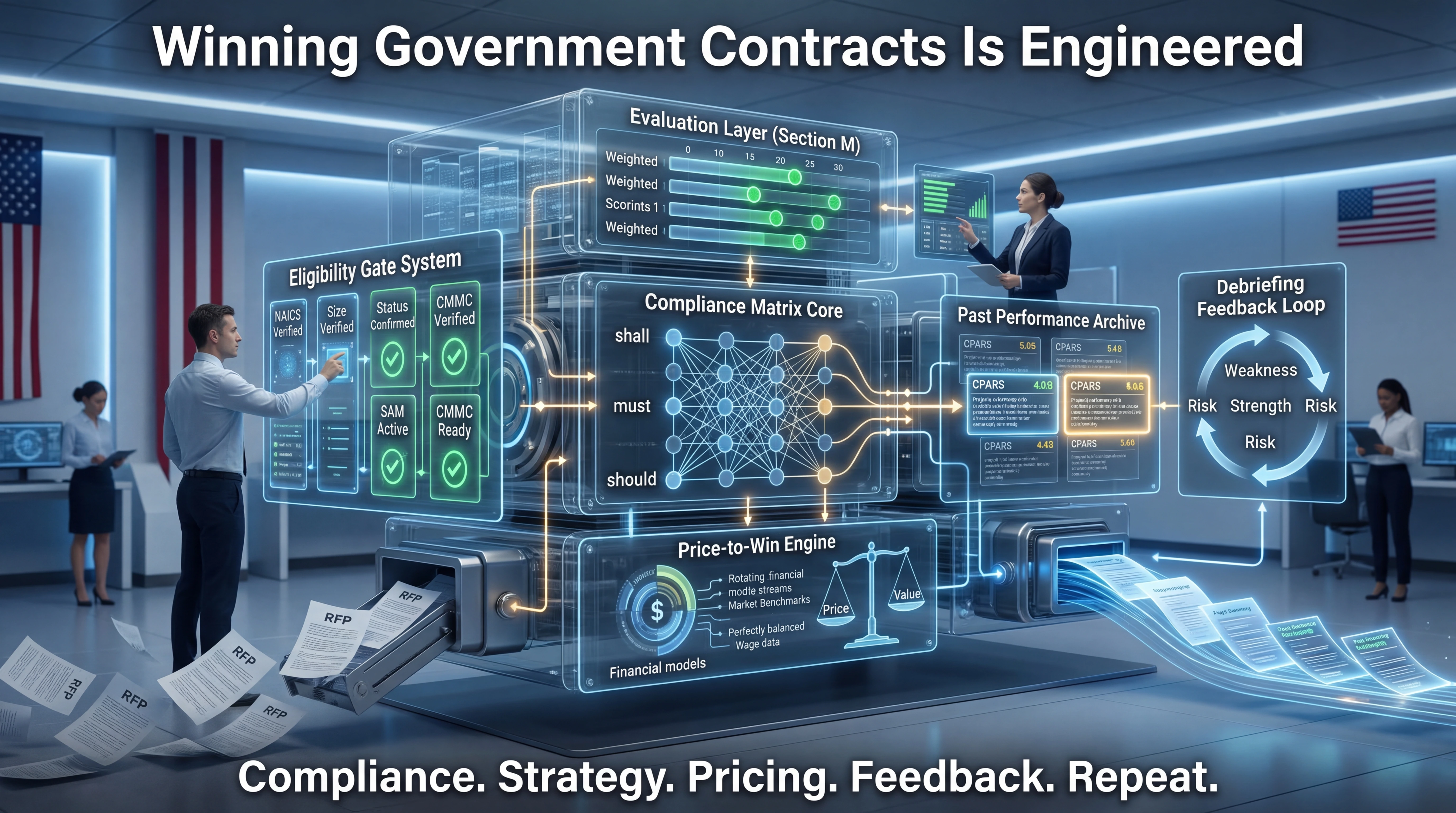
This article walks you through the discipline of win rate optimization for U.S. government proposals — the deliberate, repeatable practices that separate companies who consistently win federal work from those who burn time and money on losing bids. By the end, you will understand how to read and respond to a solicitation’s grading rubric, how to pass eligibility gates before you waste a dollar, how to build a defensible price, and how to turn losses into future wins through structured debriefings. Whether you are figuring out how to win government contracts for the first time or you are a capture director looking to sharpen an already mature pipeline, every section is designed to give you something you can act on immediately.
What This Article Covers — and Why It Matters
By the end of this guide, you will understand:
- How to read and respond to Section L and Section M evaluation factors under FAR Part 15
- How to build a proposal compliance matrix that mirrors the evaluator’s checklist
- How to optimize for LPTA versus best-value tradeoff source selections
- How to clear eligibility gates — NAICS codes, the Rule of Two, the Nonmanufacturer Rule, and subcontracting plans
- How to structure teaming, manage OCI risk, and build past performance
- How to run a Price-to-Win analysis anchored to market data
- How to use debriefings and GAO protest timelines as calibration tools
Read the Grading Rubric Before You Write a Word
Federal solicitations are not vague wish lists. In a negotiated acquisition conducted under Federal Acquisition Regulation (FAR) Part 15, the government is required to tell you exactly how it will score your proposal [3]. That scoring guide lives in two places inside the solicitation: Section L (Instructions to Offerors — what to submit and how to format it) and Section M (Evaluation Factors — what the government cares about most and how it will weigh each factor). Think of Section L as the exam instructions and Section M as the answer key’s point distribution.
Your first move after downloading a solicitation should be building a proposal compliance matrix. This is a spreadsheet — nothing fancy — that maps every requirement word (shall, must, should, will) from Sections L, M, the Statement of Work (SOW), and the Performance Work Statement (PWS) to a specific location in your response. If the solicitation says “the offeror shall describe its quality management approach,” your matrix shows exactly which paragraph of Volume II addresses it. Evaluators often use a checklist derived from these same words; if your matrix is complete, your proposal mirrors their checklist. FAR 15.304 and 15.305 lay out how agencies structure evaluation factors and subfactors, and how those factors must be applied consistently [3]. Write to them in the order the government lists them — do not reorganize to suit your own narrative preference.
Not every opportunity uses Part 15 procedures, though. Orders placed against Federal Supply Schedules (FAR Subpart 8.4) or task orders under Indefinite-Delivery/Indefinite-Quantity (IDIQ) contracts (FAR 16.505) follow streamlined procedures [5][6]. You will not see formal Sections L and M; instead, the agency issues a Request for Quotations (RFQ) or a fair-opportunity notice with its own evaluation criteria. The principle is identical: mirror the document’s structure, address every stated factor, and prove your value against exactly what the agency says it will measure.
LPTA vs. Best-Value Tradeoff: Optimize for the Right Game
Before you draft a single sentence, determine which source-selection method the agency is using. The FAR defines two primary approaches, and they demand fundamentally different strategies.
| Attribute | LPTA — FAR 15.101-2 | Best-Value Tradeoff — FAR 15.101-1 |
|---|---|---|
| What wins | Lowest price among proposals that meet every technical requirement | Proposal offering the best combination of price and non-price factors (even if not cheapest) |
| Strategy focus | Compliance, risk minimization, no unnecessary extras | Discriminators, documented strengths, compelling value narrative |
| Past performance role | Usually acceptable/unacceptable gate | Often a separately weighted factor — depth and relevance matter |
| Price approach | Drive price as low as possible while remaining compliant and realistic | Price must be fair and reasonable; invest in explaining why your price represents value |
Misidentifying the source-selection type is one of the fastest ways to lose. Submitting a rich, discriminator-heavy technical volume for an LPTA evaluation wastes pages and may actually increase evaluated risk if the agency suspects you are over-engineering. Conversely, a bare-minimum response in a best-value tradeoff surrenders every opportunity to earn evaluated strengths — the currency evaluators use to justify paying more for a superior solution.
Clear the Eligibility Gates First
Before you invest capture dollars, confirm you are eligible to compete. Eligibility mistakes are the most preventable — and the most painful — reason companies lose.
NAICS Codes and Size Status
Every solicitation assigns a North American Industry Classification System (NAICS) code — a six-digit number that classifies the work and determines which Small Business Administration (SBA) size standard applies. Your company’s size (small or other-than-small) is determined at the NAICS code level, not company-wide [8]. A firm that qualifies as small under one NAICS code may be large under another. GovBidLab’s free NAICS Code Lookup tool lets you verify the correct code and its associated size standard in seconds.
The Rule of Two
For acquisitions between the Micro-Purchase Threshold (MPT) — generally $10,000 — and the Simplified Acquisition Threshold (SAT) — generally $250,000 (both current as of March 2026 per FAR 2.101 [1]), agencies must set the work aside exclusively for small businesses when the contracting officer expects at least two responsible small businesses will submit offers at fair market prices (FAR 19.502-2) [7]. If you are a large business looking at an opportunity in that dollar range, expect a set-aside — and plan your teaming accordingly.
The Nonmanufacturer Rule
If your company is a small business reselling a product you did not manufacture, the Nonmanufacturer Rule (13 C.F.R. 121.406) requires that the end product come from a small-business manufacturer — unless SBA has granted a waiver for that product class [8]. Overlooking this rule on a supply set-aside can result in a size protest and loss of the award.
Subcontracting Plans for Large Primes
Other-than-small prime contractors must submit a small-business subcontracting plan when the contract value reaches $750,000 (or $1.5 million for construction) under FAR 19.702 [7]. Proposal volume owners should check the solicitation carefully: some agencies treat the subcontracting plan as a go/no-go compliance gate, while others weight it as an evaluated factor. Missing or perfunctory plans have caused otherwise competitive proposals to be rated unacceptable.
Registrations
Before you can receive a federal award, your firm needs an active registration in the System for Award Management (SAM.gov), which requires a valid Unique Entity Identifier (UEI). You can verify your UEI status quickly using GovBidLab’s free UEI Lookup tool. If you are pursuing Department of Defense (DoD) work involving Controlled Unclassified Information (CUI), you will also need to assess your readiness for Cybersecurity Maturity Model Certification (CMMC) — GovBidLab’s CMMC Calculator can help you gauge where you stand.
Teaming, Conflicts, and Past Performance
Teaming with the right partners — as a prime contractor or subcontractor — is one of the most effective levers for learning how to win government contracts. A strong teammate can fill capability gaps, contribute relevant past performance, satisfy small-business participation goals, and bring incumbency knowledge. But teaming introduces risk if not structured carefully.
Organizational Conflicts of Interest (OCI)
FAR Subpart 9.5 [10] requires agencies to identify and mitigate situations where a contractor’s existing work could give it an unfair advantage or impair its objectivity. The classic example: a firm that helped draft a requirement (systems engineering and technical assistance, or SETA work) then bids on the resulting contract. If your company — or a proposed teammate — has SETA, advisory, or specification-drafting history on the program, document a mitigation plan before you submit. Evaluators who spot an unaddressed OCI will rate it as a significant weakness or, worse, find you ineligible.
Past Performance and the “Neutral” Rating
If your firm has no relevant past performance record, the government cannot hold that against you. FAR 15.305(a)(2)(iv) requires that offerors without a past performance history receive a “neutral” rating — lack of record may not be evaluated unfavorably [3]. This is a critical protection for new entrants. However, neutral is not the same as a strength. In a best-value tradeoff, competitors with documented successful performance on similar contracts will outscore a neutral rating every time. Building a Contractor Performance Assessment Reporting System (CPARS) track record — even through subcontracting — is one of the highest-return investments a growing firm can make.
To present your qualifications compellingly — whether in a proposal, at an industry day, or during a capabilities briefing — a polished capability statement is essential. GovBidLab offers a free Capability Statement Generator that formats your core competencies, past performance, and differentiators into a professional, government-ready document.
Price-to-Win: A Discipline, Not a Guess
Price-to-Win (PTW) is the analytical process of estimating what price — at a given technical and management approach — gives you the highest probability of winning. It is not undercutting the competition blindly. It is aligning your cost structure to what the agency considers fair, reasonable, and realistic relative to the evaluated technical merit of your offer.
Start with the solicitation’s pricing evaluation language. The agency must determine price reasonableness (FAR 15.404-1(b)) — meaning your price cannot be so high that it lacks market support, nor so low that it signals a misunderstanding of the work [3]. For cost-reimbursement contracts, the government will perform a cost realism analysis (FAR 15.404-1(d)), adjusting your proposed costs to what the agency believes the work will actually cost — even if you proposed less. Underbidding on a cost-reimbursement vehicle does not save you; it gets your cost adjusted upward and may generate a weakness for unrealistic estimating. For firm-fixed-price contracts, cost realism analysis applies only when the solicitation expressly says so [3].
Anchor your labor categories and indirect rates to verifiable market data. Cite published Bureau of Labor Statistics (BLS) wage data, General Services Administration (GSA) Schedule pricing, or Defense Contract Audit Agency (DCAA)-audited rates where available. For work covered by the Service Contract Labor Standards (SCLS) — formerly the Service Contract Act — under FAR 22.1003 [11], your pricing must comply with the applicable Wage Determination issued by the Department of Labor. Failing to price at or above those minimums can trigger a realism adjustment and a risk finding.
For commercial acquisitions using Simplified Procedures for Certain Commercial Products and Commercial Services (FAR 13.5), streamlined thresholds apply — generally up to $7.5 million, or up to $15 million for certain contingency, defense, or national-security requirements [2]. Under these procedures, agencies favor low-risk, readily understandable solutions. Prune novelty. Emphasize proven commercial solutions and clear delivery terms. Complexity that adds evaluation risk works against you.
For IDIQ task order proposals, tailor every response to the ordering activity’s specific fair-opportunity factors (FAR 16.505(b)(1)) [6]. Demonstrate staffing agility: name key personnel, attach current resumes, and include letters of commitment. Ordering officers evaluate whether you can start fast and perform with minimal ramp-up — show them you can.
Turn Every Loss Into a Future Win: Debriefings and Protest Timelines
The companies that consistently learn how to win government contracts treat debriefings not as post-mortems but as engineering data. Every debriefing is a calibration opportunity — a chance to see your proposal through the evaluators’ eyes.
Postaward debriefings are available upon request for FAR Part 15 procurements (FAR 15.506) [4]. For task orders under IDIQ contracts, debriefings are available when the order exceeds $6 million (FAR 16.505(b)(6)) [6]. During the debriefing, the agency will share your proposal’s evaluated strengths, weaknesses, and deficiencies; your overall rating under each evaluation factor; and the rationale for the award decision (though not the awardee’s proprietary information or trade secrets).
For DoD procurements, enhanced debriefing procedures under the Defense Federal Acquisition Regulation Supplement (DFARS) extend the question-and-answer period and can affect downstream protest timing. Track agency-specific instructions carefully.
If you are considering a protest to the Government Accountability Office (GAO), timing is critical. To obtain an automatic stay of contract performance — meaning the agency must pause work on the awarded contract while GAO considers your challenge — you generally must file within five days after the debriefing date, as required by the Competition in Contracting Act (31 U.S.C. §3553) and GAO’s Bid Protest Regulations (4 C.F.R. Part 21) [9]. Missing this window does not bar a protest entirely, but it eliminates the automatic stay, dramatically reducing your leverage.
Whether you protest or not, capture every piece of feedback from the debriefing and feed it back into your process. Mature government capture management organizations build a closed-loop system:
- Record every evaluated strength, weakness, significant weakness, and risk from the debriefing.
- Map weaknesses to specific proposal sections and root causes — was it a writing clarity problem, a staffing gap, a pricing outlier, or a genuine capability shortfall?
- Update your color-team review checklists: Pink Team (for structure and outline completeness), Red Team (for compliance coverage and strength density), and Gold or White Glove review (for final polish, readability, and graphics quality).
- Track leading indicators of Probability of Win (Pwin) over time: evaluated strengths per page, Section M factor coverage percentage, and the ratio of evaluator-ready graphics to text-heavy narrative.
- Feed debriefing insights upstream, too — into your pre-RFP shaping activities such as responses to Sources Sought notices, Requests for Information (RFIs), and one-on-one meetings with program offices. Shaping the requirement before the solicitation drops is where win rates are built, not just defended.
Putting It All Together: The Win Rate Optimization Framework
Optimizing your win rate is not about any single tactic. It is about connecting every phase — from opportunity identification and capture planning through proposal writing, pricing, and post-submission learning — into a disciplined, repeatable system. Here is the framework in summary:
Before the solicitation drops:
Shape the requirement through industry engagement; validate your NAICS code and size status; identify and lock in teammates; resolve any OCI exposure; build or refresh your capability statement.
When the solicitation drops:
Build your compliance matrix from Sections L and M (or from the RFQ/fair-opportunity notice); determine whether you are in an LPTA or best-value tradeoff; assign volume owners and price leads; run your PTW analysis against market data and wage determinations.
During writing and review:
Write to the evaluation factors in order; run color-team reviews calibrated to the solicitation’s scoring structure; verify every “shall” and “must” is answered; ensure named key personnel have current resumes and letters of commitment attached.
After submission:
Request your debriefing; capture every data point; update your color-team checklists and Pwin tracking; decide whether the facts support a GAO protest within the five-day window — and if not, invest that energy in winning the next one.
Understanding how to win government contracts is ultimately about respecting the system the government has built — reading the rules as written, responding to what evaluators actually score, and treating every outcome as data that makes your next proposal stronger.
What to Do Next
Pick your next active opportunity and build a compliance matrix from its Section L and Section M (or equivalent RFQ factors) before you write a single proposal sentence. If you do not have an active opportunity yet, start by confirming your firm’s basics: verify your UEI with GovBidLab’s UEI Lookup tool, confirm your NAICS code and size status with the NAICS Code Lookup tool, and generate a professional capability statement with the Capability Statement Generator. Explore all of GovBidLab’s free tools here. The companies that win consistently are the ones that prepare before the solicitation drops — start building your foundation today.
Glossary of Terms Used in This Article
Best-Value Tradeoff — A source-selection method (FAR 15.101-1) where the government can pay more for a higher-rated proposal if the additional quality or capability is worth the price premium.
BLS — Bureau of Labor Statistics — the federal agency that publishes wage and employment data often used to support labor-rate pricing in proposals.
BOE — Basis of Estimate — the documented rationale explaining how you calculated your proposed costs or hours.
CICA — Competition in Contracting Act — the federal law (31 U.S.C. §3553) that governs competitive procurement requirements and the automatic-stay mechanism for GAO protests.
CMMC — Cybersecurity Maturity Model Certification — a DoD framework requiring contractors handling sensitive information to meet specific cybersecurity standards.
Compliance Matrix — A spreadsheet mapping every solicitation requirement to the exact location in your proposal where it is addressed.
CPARS — Contractor Performance Assessment Reporting System — the government’s database for recording and reviewing contractor performance evaluations.
CUI — Controlled Unclassified Information — sensitive but unclassified government information that requires safeguarding.
DCAA — Defense Contract Audit Agency — the DoD agency responsible for auditing contractor costs and accounting systems.
DFARS — Defense Federal Acquisition Regulation Supplement — additional acquisition rules that apply specifically to DoD procurements.
DoD — Department of Defense.
FAR — Federal Acquisition Regulation — the primary set of rules governing how federal agencies buy goods and services.
GAO — Government Accountability Office — the independent agency that adjudicates bid protests filed by disappointed offerors.
GSA — General Services Administration — the federal agency that manages government-wide contracts, including Federal Supply Schedules.
IDIQ — Indefinite-Delivery/Indefinite-Quantity — a contract type that provides for an indefinite quantity of supplies or services over a fixed period, with individual task or delivery orders placed as needs arise.
LPTA — Lowest Price Technically Acceptable — a source-selection method (FAR 15.101-2) where the award goes to the lowest-priced proposal that meets all technical requirements.
MPT — Micro-Purchase Threshold — the dollar limit (generally $10,000 as of March 2026) below which agencies can make purchases without competitive bidding.
NAICS — North American Industry Classification System — six-digit codes that classify business activity; each code has an associated SBA size standard.
Nonmanufacturer Rule — An SBA rule (13 C.F.R. 121.406) requiring small-business resellers on set-aside supply contracts to provide products made by small-business manufacturers, unless a waiver applies.
OCI — Organizational Conflict of Interest — a situation where a contractor’s existing work could give it an unfair competitive advantage or compromise its objectivity.
PTW — Price-to-Win — the analytical process of estimating the optimal price point that maximizes your probability of winning.
Pwin — Probability of Win — a qualitative or quantitative assessment of how likely you are to win a given opportunity.
PWS — Performance Work Statement — a solicitation document describing required outcomes and performance standards (as opposed to prescribing how to do the work).
RFI — Request for Information — a pre-solicitation notice where the government gathers market research from industry before drafting a formal solicitation.
RFQ — Request for Quotations — a solicitation document used for simplified or schedule-based acquisitions, asking vendors to submit pricing and capability information.
Rule of Two — The FAR requirement (19.502-2) that acquisitions between the MPT and SAT be set aside for small businesses when at least two responsible small businesses are expected to compete at fair prices.
SAM.gov — System for Award Management — the government’s official registration database; active registration is required to receive federal contract awards.
SAT — Simplified Acquisition Threshold — the dollar limit (generally $250,000 as of March 2026) below which agencies may use simplified purchasing procedures.
SBA — Small Business Administration — the federal agency that sets small-business size standards and administers small-business contracting programs.
SCLS — Service Contract Labor Standards (formerly Service Contract Act) — the law requiring contractors on service contracts to pay employees at least the prevailing wages and benefits set by Department of Labor wage determinations.
Section L — The section of a federal solicitation that provides instructions to offerors — what to submit, how to format it, and page limits.
Section M — The section of a federal solicitation that describes the evaluation factors, subfactors, and their relative importance.
SETA — Systems Engineering and Technical Assistance — advisory and technical support services provided to a government program office, which can create OCI issues for future competitions.
SOW — Statement of Work — a solicitation document prescribing the specific tasks, deliverables, and methods the contractor must perform.
UEI — Unique Entity Identifier — the alphanumeric code assigned to every entity registered in SAM.gov, required for federal contracting.
References
- FAR 2.101 — Definitions (including Micro-Purchase Threshold and Simplified Acquisition Threshold). General Services Administration, Department of Defense, National Aeronautics and Space Administration. acquisition.gov/far/2.101
- FAR 13.500 — Simplified Procedures for Certain Commercial Products and Commercial Services. acquisition.gov/far/subpart-13.5
- FAR Part 15 — Contracting by Negotiation (including 15.101-1, 15.101-2, 15.304, 15.305, 15.404-1, 15.506). acquisition.gov/far/part-15
- FAR 15.506 — Postaward Debriefing of Offerors. acquisition.gov/far/15.506
- FAR Subpart 8.4 — Federal Supply Schedules. acquisition.gov/far/subpart-8.4
- FAR 16.505 — Ordering (including Fair Opportunity and Debriefings for orders exceeding $6M). acquisition.gov/far/16.505
- FAR Part 19 — Small Business Programs (including 19.502-2 Rule of Two and 19.702 Subcontracting Plans). acquisition.gov/far/part-19
- 13 C.F.R. Part 121 — Small Business Size Regulations (including 121.406 Nonmanufacturer Rule). Small Business Administration. ecfr.gov/current/title-13/chapter-I/part-121
- 31 U.S.C. §3553 (Competition in Contracting Act — Automatic Stay) and 4 C.F.R. Part 21 (GAO Bid Protest Regulations). Government Accountability Office. gao.gov/legal/bid-protests/regulations-background
- FAR Subpart 9.5 — Organizational and Consultant Conflicts of Interest. acquisition.gov/far/subpart-9.5
- FAR 22.1003 — Applicability of Service Contract Labor Standards. acquisition.gov/far/22.1003